Showing posts with label architecture. Show all posts

Wednesday, June 19, 2013

"Bici en el Barrio Viejo" in this week's "Apps Uncovered"

This past spring, I went on a photo-walk in Tucson's Barrio Viejo...
...and one of the scenes from that day is featured in this week's "Apps Uncovered" by iphoneographycentral.com:


"Bici en el Barrio Viejo, Tucson"

Backstory/Apps Used: Just south of downtown Tucson, the architectural soul of the city--
Sonoran adobe rowhouses from the 19th-c., unique in the U.S. 
(iPhone5, snapseed, iwatermark)

It's an honor to have this photo in this week's showcase; there is some amazing work in this week's selections!

The "Apps Uncovered" series is such a good place to learn from--the 'backstory' for each image gives you a bit of a behind-the-scenes look into the 'toolbox' the photographer/artist used.

For this particular image, as you can see, the only app I used was snapseed. (iWatermark is just used for my 'signature' in the corner.) I used the crop-tool to make the scene into a square, and then the 'drama' filter allowed me to bring out the texture of the wall. I used the 'center focus' tool just very lightly for a slight vignette. 

New apps keep coming out every week, but snapseed remains my 'go-to' app--even when I use others for different effects, I usually begin and end the process with snapseed.


Tuesday, April 23, 2013

In Tucson's Barrio Viejo...

This past weekend, The Tucson Historic Preservation Foundation organized a "Historic Adobes of Barrio Viejo" Tour--a rare opportunity to get an inside view of some of the oldest homes in the architectural soul of the city--the Sonoran rowhouses of the 19th century. It was a singular combination of sanctioned voyeurism and exhibitionism--'ok'd' by the historicity of it all...

No interior photography was allowed, but I did take my iPhone with me, so here are a few shots of the streetscape:


It feels so much more Mexican or Mediterranean than "Wild West US"...It's almost unbelievable to think that in the 1960's, blocks and blocks of this architecture was just torn down to make room for the Tucson Convention Center. (Before the days of gentrification--when this neighborhood was mostly Latino, with Chinese corner-grocers...) 

Just incredible. Tucson could've had a downtown as architecturally and as historically compelling as Santa Fe, NM--unified and with an authentic sense of place...Alas, just relics are left--but still enough for a worthy stroll or bike-ride...No other city in the U.S. has this collection of Sonoran architecture.


Some of the wrought-iron details:
--gotta love the cat-and-mouse sense of humor in this window...
...and the rattlesnake almost has a cute face...

creative tortoise-lock:

--and the old Teatro Carmen:
(this was not taken on my iPhone,
but I did use snapseed to edit it)
This particular alleyway has always reminded

...and, from a couple of years ago,
a serendipitous rainbow over a renovated adobe façade:


Monday, March 18, 2013

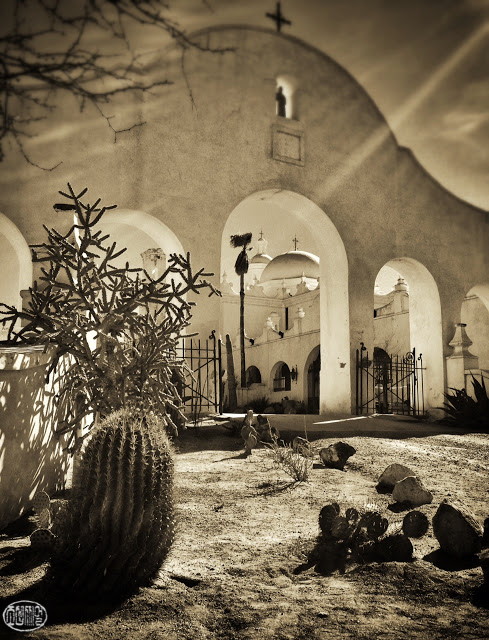
"white dove of the desert"--the Mission San Xavier del Bac

A few afternoons ago, I was able to leave work a bit early...so I took advantage of the warm spring day to explore a bit--I went down to the Mission San Xavier del Bac, one of the earliest European structures to be built in Arizona. 

Only a 15-minute drive down I-19 from downtown Tucson, the 18th-century mission is one of the best examples of Spanish colonial architecture in the U.S.--the "white dove" of neo-Baroque and Moorish influences is still a parish church of the Tohono O'odham people today, over three centuries after Padre Kino first ventured up into what the Spanish Empire labeled "Pimería Alta." 

Desert sky, Native American culture, Spanish architecture--this is definitely a nowhere-else-but-Tucson kind of place, and endlessly photogenic. So. A few iPhone shots...

Traditional saguaro rib-mesquite log-ocotillo branch ramadas line the plaza in front of the Mission, where local Tohono O'odham families often sell regional food and drink...

View from the side chapel
(the slight 'fish-eye' effect
obtained by using the built-in panorama
mode in the iPhone5)

And here's the door handle on the Mission's entrance:

While a rattlesnake is an environmentally appropriate motif for a desert building, I can't help but wonder how many visitors note the irony of having a serpent 'guarding the entrance' to a church? (re-read Genesis, anyone?)

Inside--definitely baroque:

Look carefully at the cloth covering the altar:

It's the 'trademark' motif of the Tohono O'odham--the man-in-the-maze:

And some more of the Baroque interior--note the Native American statue on the right:


This is Ketari Tekakwitha, a 17th-c. Algonquin woman who was canonized, last year, as the first Native American Saint in the Catholic church...

The rear entrance to the courtyard of the Mission...

==========================

Totally unrelated to the Mission, the scene below,
but this striking street-art was on my way--
I've passed it so many times, but had never stopped to photograph it:
the Heart mural on the corner of Stone & Speedway:

(Bright colors and skulls--the pre-Hispanic and Hispanic influence of the Day of the Dead)

Sunday, November 25, 2012

a week of symmetry and its surreal revelations...

A week ago, I took my iPhone with me on my morning run--a glorious autumn morning in Sabino Canyon, great for reflection shots...

...Later that evening I was playing around with a couple of the scenes--turned one into a black-and-white, and then thought it might be fun to 'mirror' the black and white version, lining it up with the original color photo, using the PicFrame app to place the photos side-by-side, and then 'erasing' the space between the photos by reducing the width to zero; below is the result:


A bit trippy; I was pleased with how it turned out.

So, the next day, while on my lunch break, I thought I'd play around with 'mirroring' another photo--from a recent trail-run into Bear Canyon. When I finished flipping the photo and placing it next to the original, I was surprised by what I saw staring back at me:


Symmetry brings out unforeseen patterns;
the brain wants to impose sense;
faces and anthropomorphic figures pop out.

Surreal.

So then--back to a reflective landscape from Sabino Canyon--
cottonwoods glowing under the desert sun...
I was floored by the result: 
 Whoa.
That face at the bottom...
With its enigmatic Mona-Lisa-smile--
serendipity of underwater undulations in the sand and gravel...

Onto a monsoon downpour over the desert--
 vague notions of a UFO in the sky;
weather marching ominously over the saguaros:


 From the Sonoran desert to Seoul--from landscapes to architectural details--the roof of the Throne Hall of Gyeongbok Palace--flipped on its side and mirrored:
 --fractal, almost...

And then from the traditional to the post-modern, still in Seoul--Daniel Liebeskind's "Tangent" (HQ for Hyuundai Development Company), "cubed:"

...back to landscape.
Can you recognize where this melting scene comes from?
 (Is that a rock-star's face in the middle?)
Mt. Rainier.

The idea of faces--I went back to my Sabino Canyon landscape with the eerie face--decided to triple it:

Without getting overly theological,
it's interesting to see a trinitarian head appear where,
in nature, there's nothing...

Back to Seoul:
a floating roof, 
guarded by two 'haetae:'

More architecture--the Loreto Chapel's 'miraculous' spiral staircase in Santa Fe, NM...
the spiral becomes the infinitely impossible:

 Radial symmetry can be hypnotic.

Some sculpture--the 'tree of hearts' on a jetty jutting out into the Sea of Japan,
in Sokcho, along the NE coast of S. Korea:

St. Louis' Gateway Arch becomes a gaping celestial maw:
The 18th-century San Francisco de Asis adobe church in Taos, NM
transforms into an evocation of a moai head from Easter Island, no? 


And now, back to Tucson for something from just a few hours ago. 
With some out-of-town friends, we went for an evening walk in Sabino Canyon...this time, my eye looking for shadow-and-rock jutting into the sky, wondering what symmetry will reveal...Below, a before-and-after comparison of a mountaintop:

And here's a close-up of the cropped-copied-and-rotated end-result:
 Vaguely Mayan?
A carved bar of gold?
Eagles? Foxes? Jaguar heads?

To conclude,
a couple more scenes from Seoul--
Korean architecture just seems to lend itself to 
this kaleidoscopic treatment: 
--one of the stone 'haetae' (mythical fire-eating dragon-dogs) guardian statues in front of Gwanghwamun gate, the main ceremonial entrance to the Joseon-dynasty-era Gyeongbok Palace, in the center of Seoul. 

This last one is a 'transplant'--I'd taken the photo (of Bigak pavilion, a monument on a busy intersection in Seoul) with my Canon, but then e-mailed it to my iPhone so I could play with it with PicFrame--the intricately painted eaves, coming at you from the night sky...

What's coming at you? What do you see?

Thursday, June 21, 2012

"early blooms" and 'updated' Peruvian scenes

...always a fun surprise to see a photo published in the morning paper:

(taken with my iPhone after a run in Sabino Canyon;
used snapseed to 'brighten' the flowers a bit,
and then slight 'tilt-shifting' to blur the top of the cactus)

=======================================
A couple of weeks ago, I 'rehabilitated' some old snapshots of Switzerland;
 this week I did the same for some photos from a trip to Perú.

On the flight down to South America, our camera got left on the plane! Of all places to be--Perú!--with NO camera!? So we had to buy a camera down there--I still wasn't ready yet to make the switch to digital, which would have been prohibitively expensive anyway, given our travel budget...So we got a point-and-shoot film camera and made do.

Thinking back, it was like having a 'toy camera' of sorts...and so I went for the 'toy camera' effect when editing these 'transplanted' shots with snapseed--using plenty of vignetting and tilt/shifting or 'center-focusing.'


The 'campiña' (countryside) outside of Arequipa,
(Perú's second-largest city, about 8000 feet up on an Andean plateau
in the south of the country)
with the El Misti volcano looming above
pre-Inca terraces still being farmed:
 One of the baroque 'sillar' (white volcanic stone) courtyards
built during the colonial era in Arequipa:

The next four photos are also from Arequipa. In 1580, just four decades after the Spanish founded the city, the Monastery of Santa Catalina de Siena was established. Wealthy families paid lavish dowries in order for their daughters to become nuns here. (The existence of servants' and slaves' quarters, along with the nuns' lodging, testifies to the curious luxury that accompanied the isolation here.) A veritable city-within-a-city, this complex has been open to the public since the 1970's.


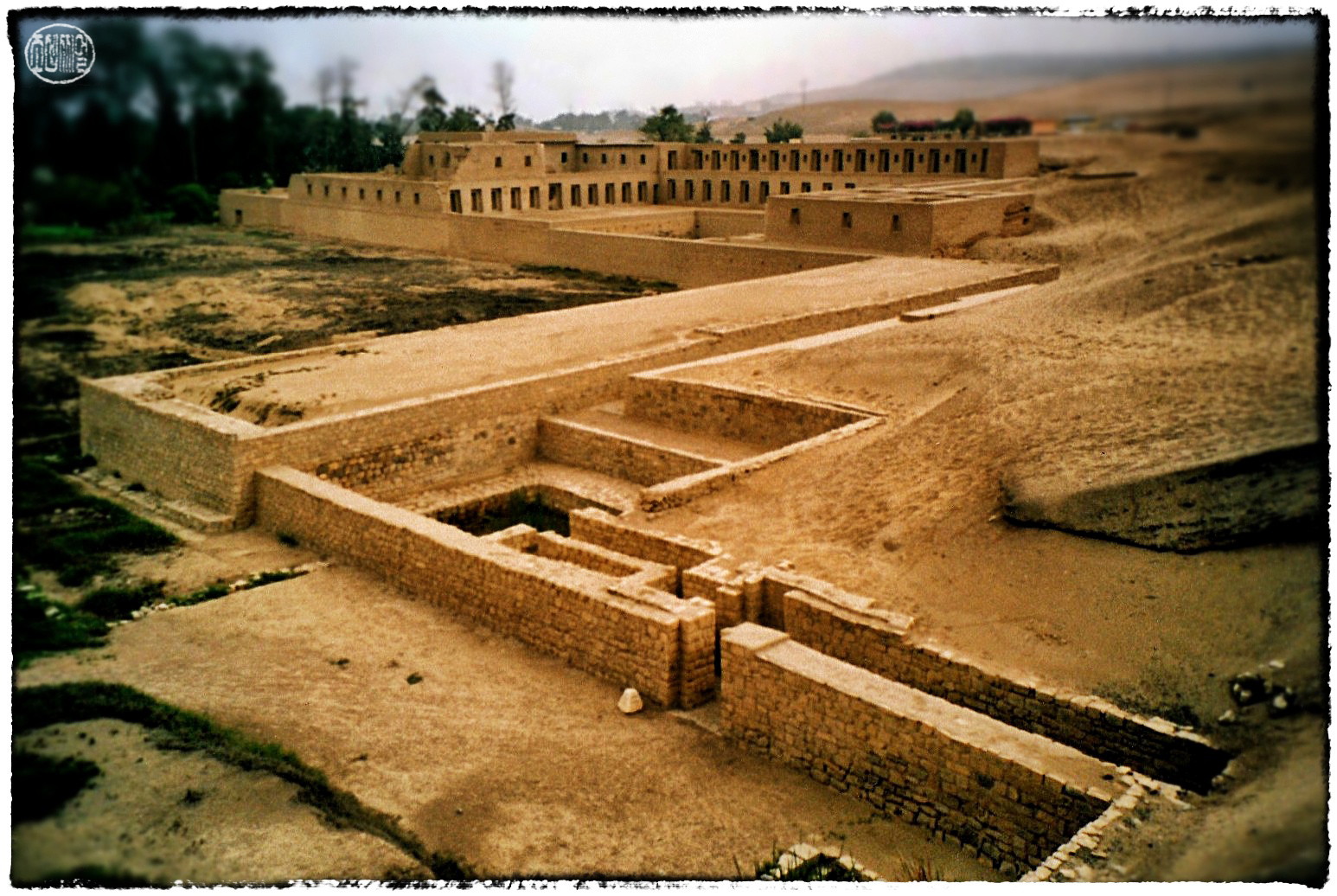
Now, down to the arid coast around Lima. The capital itself is dotted with excavations of pre-columbian cultures, but in Pachacámac, about 18 miles/30 km SE of the city, the ruins literally spill out of the sandy hills above the ocean. I visited mid-week--there seemed to be more archaeologists than tourists. Temples and tombs cause archaeologists to continually push back the date for the origins of civilization in this part of South America.  Pachacámac is one of the easiest-to-get-to pre-Inca locations to visit and learn more about these societies. On a quiet mid-week visit, it's sobering to wander the ruins of was once a vibrant complex...


 ...and below is the 'pre-Snapseed' snapshot; using a 'gentle touch' with one of the 'drama' filters brings out the texture of the sand, and then vignetting draws your eye toward the zig-zagging passageway...

a girl and her sheep,
on the Altiplano on the way to the Cañon del Colca:

mid-morning in
Machu Picchú:


Thursday, May 17, 2012

two-fingered end-of-the-school-year fun...astronomers in L.A....a Uruguayan's tower


A student of mine was having finger-art fun--and I just had to take a couple of photos.
The left might just elicit a 'huh?'...but cross those fingers, and drama ensues...
(Gracias, David!)
Just another week with kids-in-the-classroom...

Now, a scene that's been 'stuck' in my iPhone for about a year and a half:
(drama-filter and center-focus vignette)

In the hills above Los Angeles, near the Hollywood sign, Kepler, Galileo and Copernicus look out over the city of 'stars'...Dominating the lawn in front of Griffith Observatory, this Astronomers Monument dates from the 1930's; the Depression-era Public Works of Art Projects gave work to artists and beautified public spaces. (Nearby is another piece of statuary: a bust of James Dean--the "Rebel Without a Cause" monument, commemorating the film in which Griffith Observatory played a large role.) There's no better place in L.A. from which to see the city lights at night...or to look up at real stars through the free public telescopes in the observatory itself.


And a bit of architectural contrast from Seoul:

One of the most distinctive buildings in central Seoul is the 33-story Jongno Tower, a triangular glass and steel tower topped with an oval floating above seven stories of emptiness.

Across the street is the traditionally reconstructed "Bo-shin-gahk" belfry, housing a large bronze bell. During the Joseon dynasty, the bell would be rung 33 times every morning, (symbolizing the 33 heavens of Buddhism), to open the city's gates. At dusk, the bell would be rung 28 times (linked to the locations of constellations) to signal the shutting of the city's gates.The original bell is now in the National Museum, but a reproduction still hangs here, and every December 31st, it's struck 33 times to ring in the New Year.


Here's the original iPhone shot--the colorful underside of the Bell Pavilion's roof was in almost total darkness. Using the selective control point, I was able to bring out the colorfully painted eaves...

(More about the architect--Uruguayan Rafael Viñoly--and his design: